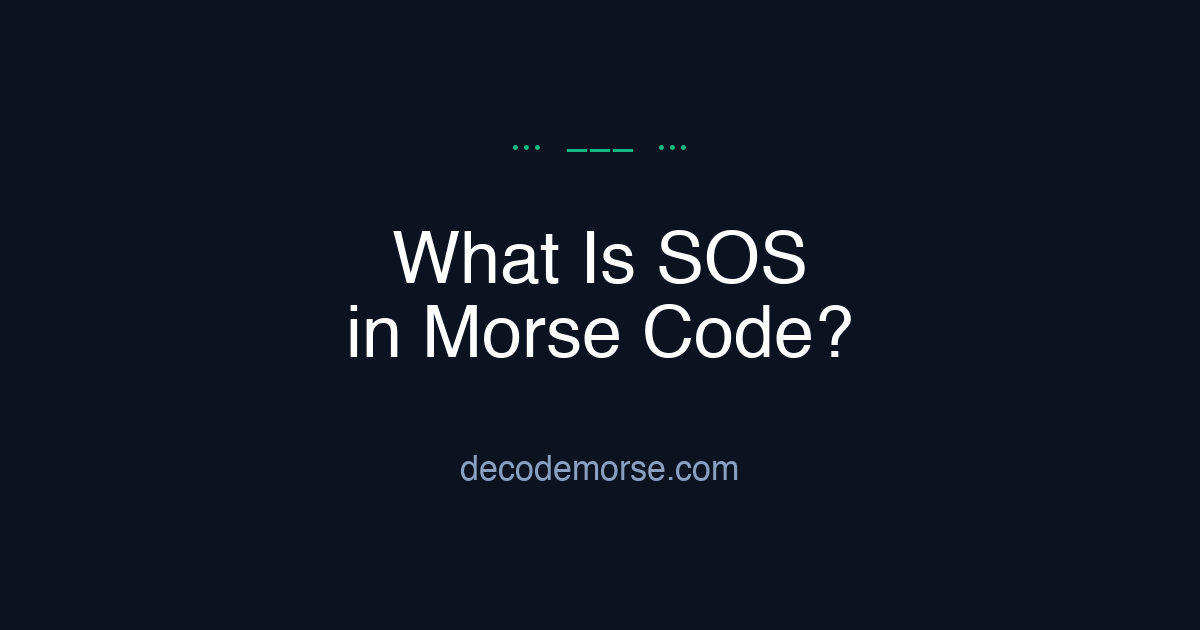
SOS in Morse code is ··· −−− ··· — three dots, three dashes, three dots, sent as one continuous signal with no letter gaps. It is the internationally recognized distress call, the single most important sequence in Morse code, and the one almost everyone has heard of even if they know nothing else about dots and dashes.
Here is the part that surprises most people: SOS does not stand for anything. Not "Save Our Souls," not "Save Our Ship," not "Send Out Succour." Those are all backronyms invented after the fact. SOS was chosen purely because the pattern is simple, rhythmic, and impossible to mistake for anything else.
You can paste ··· −−− ··· straight into the Morse code decoder to see it resolve to SOS, then play it back as audio to hear the famous rhythm for yourself.
The SOS Pattern: ··· −−− ···
| Letter | Morse | Signals |
|---|---|---|
| S | ··· |
dot dot dot |
| O | −−− |
dash dash dash |
| S | ··· |
dot dot dot |
Written out as individual letters, S-O-S would normally be ··· −−− ··· with gaps between each letter. But the distress signal is deliberately sent without those gaps — as a single nine-element string:
di-di-dit dah-dah-dah di-di-ditThat continuous run is what makes it a prosign (a procedural signal) rather than three ordinary letters. In formal notation it is written with a bar over the top — SOS — to show it is one unbroken symbol. The rhythm is so distinctive that a trained ear recognizes it instantly, even buried in static.
Why SOS Was Chosen (It's Not an Acronym)
Before SOS, there was no single worldwide distress signal. Different operators and companies used different calls. The British Marconi company used CQD (−·−· −−·− −··), where CQ was a general "all stations" call and D meant distress. The problem? CQD is long, easy to garble, and easy to confuse with the routine CQ call.
When the international community standardized distress signaling, they wanted a signal that was:
- Continuous — one rhythm with no internal gaps, so partial reception still sounds right
- Short — quick to send over and over by an exhausted or injured operator
- Unmistakable — a pattern that does not collide with common letters or abbreviations
- Symmetric —
··· −−− ···reads identically forwards and backwards, so it is recognizable even if you tune in mid-signal
The three-dots / three-dashes / three-dots pattern checked every box. The letters "SOS" are just a convenient mnemonic for the sound — a way to remember and talk about the pattern. The meaning was always the rhythm, never the letters.
When SOS Was Adopted: 1905–1908
SOS has a precise paper trail:
- 1905 — Germany adopted
··· −−− ···as a distress signal in its national radio regulations. - 1906 — The International Radiotelegraphic Convention in Berlin agreed on SOS as the worldwide standard. The signatories wrote it into the regulations to take effect on 1 July 1908.
- 1908 — SOS became the official international distress signal in force.
A persistent myth says the Titanic (1912) was the first ship to use SOS. It was not the first, but it was one of the most famous early uses: the Titanic's operators sent both the older CQD and the newer SOS as the ship went down, which helped cement SOS in the public imagination.
How to Send SOS
The beauty of SOS is that you can send it with almost anything that can be turned on and off, or made loud and quiet. The timing rule is the same in every medium: a dash lasts three times as long as a dot, and you leave a short gap between elements.
By Sound (whistle, horn, banging)
Three short blasts, three long blasts, three short blasts. Pause a few seconds, then repeat. Three of anything in a steady rhythm is widely understood as a call for help, even by people who do not know Morse.
By Light (flashlight, signal mirror, headlights)
Three quick flashes, three long flashes, three quick flashes. A signal mirror flashing SOS toward a search aircraft is a classic survival technique. At night, a flashlight works the same way.
By Radio (CW / continuous wave)
Key the transmitter: ··· −−− ···. This is still part of distress procedure for amateur and some maritime operators, though modern systems (GMDSS, EPIRBs, satellite beacons) have largely replaced manual keying for real emergencies.
Visually / On Paper
You can write it, type it, or generate audio for practice using the text-to-Morse translator — just enter SOS and the tool produces ··· −−− ···, complete with audio playback so you can rehearse the rhythm.
Important: SOS should only be transmitted in a genuine emergency. Sending false distress signals is illegal in most countries and can divert rescue resources from people who truly need them. Use the tool above to learn and practice the pattern — not to broadcast it.
SOS vs. Mayday
People often ask how SOS relates to "Mayday." They serve the same purpose but in different channels:
- SOS (
··· −−− ···) is the distress signal for Morse code / CW — dots and dashes. - Mayday is the distress call for voice radio (radiotelephone). It comes from the French m'aidez / venez m'aider ("come help me") and is spoken three times: "Mayday, Mayday, Mayday."
So if you are keying Morse, you send SOS. If you are speaking into a radio, you say Mayday. Both mean "I am in grave and imminent danger and need immediate assistance."
FAQ
What is SOS in Morse code?
SOS in Morse code is ··· −−− ··· — three dots, three dashes, three dots — sent as one continuous signal. It is the international distress call. You can confirm it by pasting ··· −−− ··· into the Morse decoder, which returns SOS.
Does SOS stand for anything?
No. SOS is not an acronym. "Save Our Souls" and "Save Our Ship" are later inventions. The pattern was chosen for its simple, continuous, unmistakable rhythm, and the letters S-O-S are just an easy way to remember that rhythm.
When did SOS become the official distress signal?
Germany adopted it in 1905, the 1906 Berlin International Radiotelegraphic Convention standardized it worldwide, and it came into force on 1 July 1908.
Why is SOS three dots, three dashes, three dots?
Because that pattern is short, symmetric (it reads the same forwards and backwards), and continuous with no internal letter gaps, which makes it recognizable even when reception is poor or you tune in part-way through.
How do I signal SOS with a flashlight?
Flash three short, three long, three short, then pause and repeat: ··· −−− ···. A short flash is a dot, a long flash (about three times the length) is a dash. The same timing works with a whistle, horn, or signal mirror.
Is SOS still used today?
The manual ··· −−− ··· signal has largely been replaced for real maritime emergencies by automated systems like GMDSS, EPIRBs, and satellite beacons. But SOS remains universally recognized, is still taught for survival situations, and is still valid in amateur radio.
Want to go further? Explore the full Morse code alphabet chart, see every digit and symbol in the numbers and punctuation reference, or learn the fastest way to memorize it all in our beginner's guide to learning Morse code.